
DIY Beach Kaftan Sewing Pattern in Cotton Pima Lawn
Published by NannetteD on Aug 27th 2026
A soft, breezy beach cover-up is one of those sewing projects that looks special without needing a complicated pattern. This easy wrap kaftan is built from simple rectangles, with two long body panels that fold continuously over the shoulders, eliminating shoulder seams and allowing the fabric itself to create the relaxed silhouette.
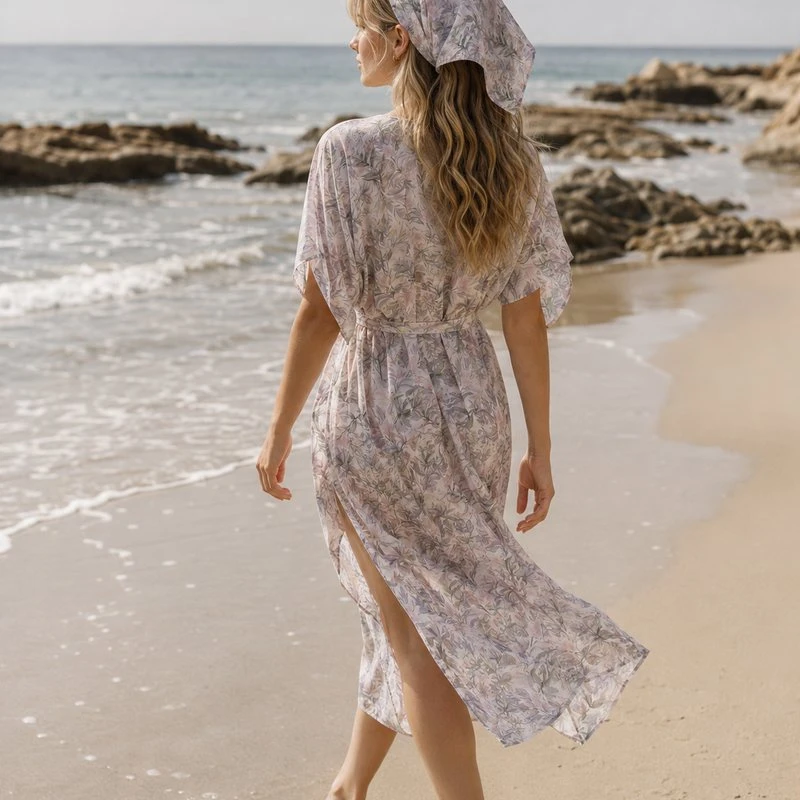
We made the coordinating set in Petal Drift printed on The Textile District's Cotton Pima Lawn, pairing the wrap kaftan with a matching tie belt and oversized bandana-style headscarf.
Cotton Pima Lawn is especially lovely for this project. It is our lightest cotton at just 2.21 oz/yd², with an exceptionally soft, silky-smooth hand and graceful drape. It feels light and breezy against the skin, while the fine woven cotton keeps hems, ties and softly flowing sleeves from becoming bulky.
There's also no need to prewash your fabric again before sewing. The Textile District's natural-fiber fabrics are steamed, washed and dried as part of our fiber-reactive printing and finishing process, so your fabric arrives ready to press, cut and sew.
Shop Petal Drift Fabric by the Yard
Choose Cotton Pima Lawn as your base fabric for this project.
What You'll Make
This simple project includes:
- One open-front wrap kaftan or beach robe
- One coordinating fabric tie belt
- One 30" square headscarf
The kaftan itself uses just two continuous body panels and two rectangular sleeves. The body panels fold at the shoulder, so there is no shoulder seam. A center-back seam joins the two panels, while simple side and underarm seams complete the garment.
This is an intentionally relaxed DIY cutting guide rather than a fitted commercial pattern, so take your own measurements before cutting and adjust the dimensions to create the amount of ease and overlap you prefer.
Fabric and Supplies
- Approximately 4 yards of The Textile District Cotton Pima Lawn for the illustrated mid-calf version
- Coordinating all-purpose sewing thread
- Fabric scissors or rotary cutter
- Long ruler or measuring tape
- Pins or sewing clips
- Sewing machine
- Iron
Optional supplies include a serger and lightweight bias binding. You can also make your own bias binding from leftover Cotton Pima Lawn for a beautifully coordinated finish.
Because Cotton Pima Lawn is a lightweight woven fabric, a fine universal or sharp needle—approximately size 70/10 or 80/12—is a good choice.
Choose Your Kaftan Width
This wrap kaftan is intended to fit loosely. Measure around the fullest part of your bust or hips, whichever measurement is larger.
Cut two continuous body panels using the following widths as a starting point:
- Up to 42" fullest measurement: 17" wide
- 43–50": 19" wide
- 51–58": 21" wide
- 59–66": 23" wide
For custom sizing, use this simple starting formula:
Panel width = (fullest body measurement + approximately 24") ÷ 4
The additional width provides both relaxed wearing ease and room for the fronts to overlap. Because this is a wrap garment, the fit is forgiving. If you prefer a particularly generous robe, add another 1–2" to each panel width.
Choose Your Kaftan Length
Measure from the top of your shoulder to the point where you would like the finished kaftan to end.
Add approximately 1" for a double-turn 1/2" lower hem. This measurement represents one half of your continuous body panel.
For example, a 50" shoulder-to-raw-hem measurement creates a continuous body panel measuring:
50" front + 50" back = 100" total panel length
After hemming, this produces a finished shoulder-to-hem length of approximately 49". That is a useful mid-calf starting length for many wearers, but the exact position will depend on height.
If you'd like a shorter beach cover-up, simply reduce both halves equally. For a longer robe, increase both halves equally.
How Much Fabric Will You Need?
The 58.5" printable width of The Textile District's Cotton Pima Lawn makes this project particularly fabric-efficient because two body panels can be cut side by side.
As a general starting guide:
- Approximately 36" finished length: about 3 1/4 yards
- Approximately 44" finished length: about 3 1/2 yards
- Approximately 48–49" finished length: about 3 3/4 yards
- Approximately 52" finished length: about 4 yards
For the mid-calf version illustrated here, we recommend starting with 4 yards. This gives you comfortable cutting room for the body, sleeves, scarf and tie belt without requiring every cut to be squeezed tightly against the next.
If you plan to make a substantially longer robe, enlarge the pieces, add pockets or carefully position particular motifs, order a little additional yardage.
A Note About Print Direction
Because each body panel runs continuously from the front hem, over the shoulder and down to the back hem, this construction works best with an all-over, tossed or non-directional design.
Petal Drift is especially well suited to the project. Its painterly botanicals move naturally across the fabric without creating an obvious top or bottom, allowing the print to flow easily over the shoulder.
If you choose a strongly directional design, use separate front and back pieces instead so the motif can remain upright on both sides of the garment.
Cut the Two Continuous Body Panels
For the illustrated version, begin with a 100" continuous length of 58.5"-wide Cotton Pima Lawn.
Cut lengthwise:
- 2 body panels at 17" × 100"
The two panels fit side by side across the fabric:
17" + 17" = 34"
This leaves approximately 24.5" × 100" along the remaining width.
Save this generous leftover section. It provides plenty of fabric for the tie belt, belt loops, self-fabric binding and optional patch pockets.
On each 100"-long body panel, measure and mark the midpoint at:
50"
This is the shoulder fold. Do not cut across this line.
Cut the Sleeves and Headscarf
Reserve another 30" length across the full 58.5" fabric width.
For the illustrated size, cut:
- 1 headscarf at 30" × 30"
- 2 sleeves at 18" × 15"
Place the 30" square scarf along one side of the fabric. Beside it, the two 18" × 15" sleeve pieces can be stacked within the same 30" fabric length.
For larger kaftan sizes, increase the sleeve attachment edge if desired:
- Up to 42": 18" × 15"
- 43–50": 20" × 15"
- 51–58": 22" × 15"
- 59–66": 24" × 15"
The first measurement is the edge that attaches to the kaftan body. The 15" measurement extends outward to form the sleeve. Shorten or lengthen that dimension if you prefer a different sleeve length.
Shape the Neckline
Lay both continuous body panels flat and clearly mark the 50" shoulder fold on each.
Designate one half of each panel as the front and the other as the back. The long inside edges will eventually form the open fronts and center-back seam.
At the shoulder fold, measure approximately 3 1/2" outward from the inside edge and mark the neckline shoulder point.
For the back neckline, measure approximately 1" down the inside edge on the back half. Draw a shallow curved line from this point to the 3 1/2" shoulder-neck point.
For the front neckline, measure approximately 9–11" down the inside edge on the front half. Draw a gentle diagonal or softly curved line from this point to the same shoulder-neck point.
Cut along the marked lines and repeat on the second panel, mirroring the neckline.
A 9" front opening creates a more modest neckline. An 11–12" opening gives the robe a deeper, more relaxed V. Before cutting deeply, it is always easier to begin conservatively and deepen the neckline later if desired.
Sew the Center Back
Place the two back halves right sides together along their center-back edges.
Beginning immediately below the shallow back neckline, sew the center-back seam to the lower back hem using a 1/2" seam allowance.
Finish the raw edges with your preferred method:
- Serger
- Narrow zigzag stitch
- Overcast stitch
- French seam
A French seam is particularly pretty on lightweight Cotton Pima Lawn if you enjoy a neatly finished interior.
Press the finished seam.
The two pieces have now become one garment body, with each continuous panel running uninterrupted:
front hem → shoulder fold → back hem
Attach the Sleeves
Keep the garment opened flat.
Take one sleeve rectangle and identify its longer attachment edge. For the illustrated size, this edge measures 18".
Find the midpoint of the 18" edge and align that point with the shoulder fold along one outside edge of the kaftan.
This places approximately:
- 9" of the sleeve attachment edge on the front
- 9" on the back
Pin and sew using a 1/2" seam allowance. Finish and press the seam.
Repeat on the opposite side with the second sleeve.
This simple rectangular construction creates a relaxed dropped shoulder without requiring a curved sleeve cap or traditional fitted armhole.
Sew the Underarm and Side Seams
Fold the kaftan at both shoulder lines with right sides together. The front panels will now fall naturally over the back.
Align the sleeve edges and body side edges.
Beginning at the sleeve hem, sew continuously:
sleeve hem → underarm → side seam
Use a 1/2" seam allowance.
For the breezy beach-cover-up look shown, stop the body side seam approximately 14–18" above the lower hem. This leaves a side slit for easy movement.
Repeat on the second side, then finish and press the seam allowances.
Finish the Front Opening and Neckline
Because Cotton Pima Lawn is so lightweight, a narrow edge treatment helps preserve the fabric's soft drape.
One of the prettiest options is narrow bias binding around the entire opening. Begin at one lower front edge and bind continuously around:
front edge → front neckline → back neckline → opposite front edge
Self-fabric bias made from leftover Cotton Pima Lawn creates an especially polished result because the binding virtually disappears into the garment.
A finished binding approximately 3/8–1/2" wide is ideal.
Lightweight coordinating commercial bias binding can also be used. Press carefully as you sew and avoid stretching the neckline.
Hem the Sleeves and Side Slits
For a delicate narrow hem:
- Turn the raw edge approximately 1/4" to the wrong side.
- Press.
- Turn another 1/4".
- Press again.
- Stitch close to the inside folded edge.
Use this treatment on the sleeve hems and side-slit edges.
The narrow double-turn hem works particularly well with Cotton Pima Lawn because it finishes the edge without adding unnecessary weight or stiffness.
Hem the Kaftan
Before hemming, try on the kaftan with the belt and check the finished length.
At the lower front and back hems:
- Turn under approximately 1/2".
- Press.
- Turn under another 1/2".
- Stitch close to the folded edge.
For an even lighter finish, you can use two 1/4" turns instead.
Make the Tie Belt
Use the long leftover fabric beside the body panels to cut 4"-wide strips.
For the illustrated size, create a finished belt approximately 80–90" long.
For larger sizes, a useful starting formula is:
Finished belt length = waist or fullest body measurement + approximately 40–50"
The extra length allows the belt to wrap and tie comfortably.
If you need to join shorter strips, sew the ends together with diagonal seams where practical. Trim the seam allowances and press them open. Diagonal joins distribute bulk more smoothly than straight crosswise seams.
To construct the belt:
- Turn each long edge inward 1/2" and press.
- Fold the entire strip in half lengthwise.
- Press again.
- Turn the short ends inward.
- Topstitch around the belt close to the edge.
A 4"-wide cut strip produces a finished belt approximately 1 1/2" wide.
For another small detail, angle the ends before folding and stitching.
Add Optional Belt Loops
Belt loops aren't required, but they can help keep the tie positioned at the waist.
Cut two narrow strips from your scraps and finish each into a small loop approximately 2 1/2–3" long.
Try on the kaftan before attaching them so you can place the loops exactly where you prefer the belt to sit.
For a true robe-style wrap, you can also make a narrow interior tie from your scraps to secure the inside front before wrapping the outer belt.
Sew the Matching Headscarf
Cut:
1 square at 30" × 30"
Finish all four sides with a narrow double-turn hem:
- Turn the edge 1/4" to the wrong side.
- Press.
- Turn another 1/4".
- Press again.
- Stitch close to the folded edge.
Keep the folds small at the corners to avoid unnecessary bulk.
If your sewing machine has a narrow-hem foot, a rolled hem is another beautiful option for this lightweight fabric.
To wear the finished scarf, fold the square diagonally into a triangle. Position the long folded edge near the hairline or slightly farther back on the crown, then tie the ends beneath or behind the hair.
The 30" square provides enough fabric to create the soft pointed drape shown in the project image.
If you'd like to make your scarf in another size or explore more ways to use it, visit our How to Sew a Bandana or Head Scarf project for additional sizing guidance and step-by-step sewing instructions.
Why Cotton Pima Lawn Works So Well
A sewing project this simple relies heavily on the fabric.
A heavier woven cotton can make the same rectangular construction feel boxy, while a very slippery fabric can make a beginner-friendly project unnecessarily difficult.
The Textile District's Cotton Pima Lawn sits in a particularly lovely middle ground. It is exceptionally soft and breezy, easy to handle at the sewing machine and light enough to move naturally when worn as a beach layer.
Our natural-fiber fabrics are digitally printed with fiber-reactive dyes and then steamed, washed and dried as part of the finishing process. The result is a soft, colorfast printed fabric that is already prepared for sewing—no additional prewashing step is necessary before starting this project.
Petal Drift also shows how much the right fabric design can contribute to an easy pattern. Its watercolor botanicals create visual movement across the broad rectangular pieces, while the non-directional composition works beautifully with a body panel that travels continuously over the shoulder.
Explore Cotton Pima Lawn & Our Fabric Selection
Compare weights, drape, printable widths and recommended sewing uses.
Make the Project Your Own
Once you understand the basic construction, this little pattern is easy to personalize.
Shorten it for an above-the-knee swimsuit cover-up. Lengthen it into a flowing ankle-length robe. Widen or shorten the sleeves. Add simple rectangular patch pockets. Make the belt narrower. Pair the robe with a scarf in a coordinating Petal Drift colorway. Or skip the belt entirely and wear the kaftan open over a swimsuit.
The pattern pieces remain wonderfully uncomplicated. That's part of the appeal: beautiful fabric does most of the design work for you.
For the illustrated mid-calf kaftan, coordinating tie belt and oversized headscarf, start with approximately 4 yards of Petal Drift printed on The Textile District's Cotton Pima Lawn and turn one length of exceptionally soft, breezy cotton into an entire handmade beach set.
Shop Petal Drift Fabric by the Yard
Select your favorite Petal Drift colorway, choose Cotton Pima Lawn and start planning your own handmade beach set.