
How to Choose Fabric for Custom Curtains
Published by NannetteD on Aug 26th 2026
Making your own curtains gives you something ready-made window treatments rarely do: the ability to choose both the fabric and the print for the room you actually have. But before deciding on a pattern, it helps to think about how you want the finished curtains to look and behave.
Should they fall softly or have a little more structure? Do you want them to filter light or provide privacy? Will the curtains be lined? And how large should the pattern feel once it is hanging across several yards of fabric?
Those decisions matter because curtain fabric isn’t simply a matter of choosing a design you like. The base fabric, weight, drape, print scale, lining and construction all contribute to the finished result.
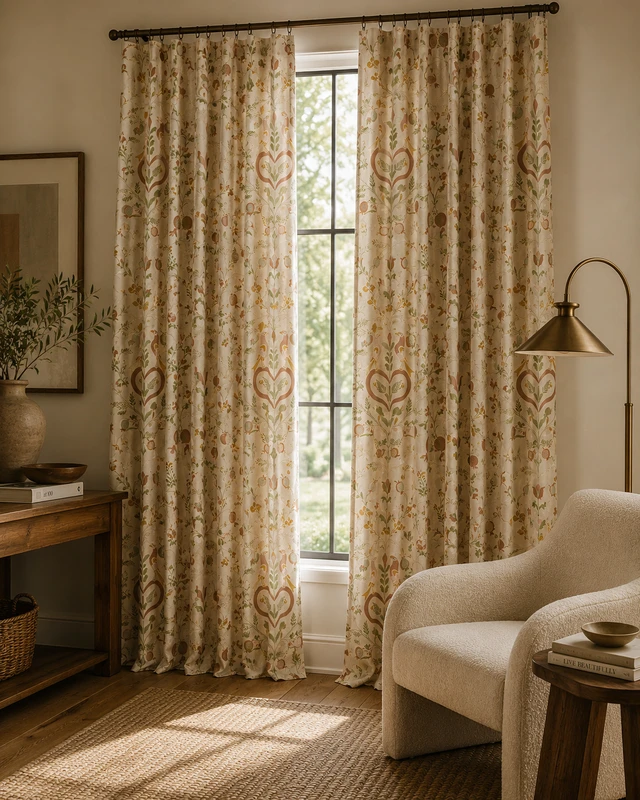
In the room shown here, Love Birds by Blair Lambert becomes the focal point without making the space feel overly decorated. Used as full-length curtain panels and surrounded by warm wood, neutral upholstery and natural textures, the pattern has room to do the work.
Start With How You Want the Curtains to Hang
Before choosing a curtain fabric, picture the finished window rather than the fabric on a sample or screen.
For relaxed curtains with softer folds, look for a fabric with enough drape to fall naturally. If you prefer a more tailored curtain with defined pleats or a stronger presence at the window, a fabric with additional body may be the better choice.
This is one reason there isn’t a single “best” fabric for curtains. A lightweight cotton, linen blend and heavier cotton can all make beautiful window treatments, but they won’t produce the same result.
At The Textile District, Cotton Linen 90/10 is a particularly useful option for decorative curtains and other interior projects. It is also a base frequently ordered by interior design shops, making it a practical place to begin if you want a fabric with subtle natural texture and enough presence for printed home decor.
Other base fabrics may make sense depending on the look you’re after. The important thing is to choose the substrate for the finished project rather than choosing by fiber content alone.
Compare Our Fabric Bases »
Explore fabric composition, weight and recommended uses before choosing a base for your curtain project.
Think About the Print at Window Scale
A pattern that looks beautiful in a small image can feel very different when it covers a pair of floor-length curtains.
Small-scale prints tend to read more like texture from across a room. Medium-scale patterns can provide noticeable pattern without completely dominating the window. Larger motifs make more of a statement and give individual elements of the artwork room to be seen.
Love Birds illustrates the latter approach particularly well. The birds, pomegranates, foliage and heart-shaped forms are large enough to remain recognizable across the folds of the curtains. Instead of becoming visual texture, the artwork becomes part of the room.
There is no rule that patterned curtains need to be subtle. If the rest of the room is relatively quiet, the window can be an ideal place for a more distinctive print.
Let One Pattern Lead the Room
If you’ve fallen in love with a patterned fabric, you don’t necessarily need to find several other fabrics that coordinate with it.
Often the easier approach is the one shown here: let the curtains carry the pattern and keep the larger pieces around them relatively simple. Warm wood, solid upholstery, a woven rug and a few familiar objects give an expressive fabric somewhere comfortable to live.
This also makes patterned curtains surprisingly adaptable. A botanical, floral, stripe, geometric or folk-inspired design can work in a traditional room, a contemporary room or somewhere between the two. The surrounding materials and furnishings have as much influence on the finished look as the pattern itself.
Consider Whether Your Curtains Should Be Lined
Lining can change both the appearance and performance of a curtain.
It can provide additional opacity and privacy, reduce the amount of light passing through the face fabric and give the finished curtain more body. A separate lining also means you don’t have to ask the decorative fabric to perform every function at the window.
The appropriate lining will depend on the room and what you need the curtains to do. Decorative living-room curtains may have very different requirements from bedroom curtains where greater light control is important.
If you are using a commercial curtain pattern, heading system or other construction method, follow its recommendations for lining and finished dimensions.
Plan Pattern Placement Before You Cut
Patterned curtains require a little more planning than solid ones, particularly when you’re making a pair.
Before cutting, identify the repeat and decide where you want the design to begin on each curtain. For a prominent motif, consider its position at the top of the curtain and how the design will appear when the curtains are hanging next to one another.
A few practical planning tips:
- Measure the window and curtain rod before calculating yardage.
- Determine the finished curtain length and fullness required by your chosen construction method.
- Check the fabric’s printable width when planning the width of each finished curtain.
- Allow for hems, the curtain heading and other construction allowances.
- Identify the vertical pattern repeat before cutting patterned fabric.
- For a pair of curtains, begin both panels at the same point in the repeat when you want the motifs to align visually.
- Purchase enough additional fabric to accommodate pattern matching rather than calculating yardage from finished dimensions alone.
Large-repeat patterns can require noticeably more yardage than solids or small allover prints. That extra fabric is what gives you the flexibility to place the design intentionally rather than allowing the repeat to determine where every curtain begins.
Don’t Forget Fullness
A finished curtain normally contains more fabric than the width of the space it covers. That additional width creates the folds that give curtains their fullness.
The amount required depends on the heading and construction style, so this is one place where it’s better to work from your chosen curtain pattern or hardware instructions than from a universal formula.
This is especially important with printed fabric. Fullness changes how much of the design you see at one time. A print that appears very open when the fabric is flat becomes more layered as the curtain gathers into folds.
Choose the Base Fabric for the Finished Project
Because our designs are printed to order across a range of base fabrics, you can choose the print you love and then select the substrate that best suits the finished project.
For curtains, that means thinking about the hand, weight, drape and surface texture you want at the window rather than being limited to whichever fabric happens to carry a particular design.
Cotton Linen 90/10 is a natural starting point for many decorative interior projects. If you want more pronounced linen character, compare it with Linen Cotton 55/45. If you prefer a smoother printed surface, Cotton Sateen may be worth considering. For projects where the look and feel of linen itself is part of the design, one of our linen bases may be the better fit.
There is no single base fabric that is automatically right for every curtain. The best choice is the one that supports the construction method, printed design and finished look you have in mind.
Compare the Fabrics Before Ordering Yardage
Fabric specifications are useful, but they can’t fully describe hand, texture, flexibility or how one fabric feels beside another.
Not sure which base fabric will give you the look you want? Our Ground Fabric Swatch Kit lets you compare the actual weight, texture and hand of our available fabric bases before ordering yardage for a larger project.
Fold the samples. Hold them vertically. Look at them beside the furniture and finishes already in the room. Compare the smoother cotton surfaces with the more textural linen and cotton-linen options. Those simple observations can make it much easier to decide which direction feels right for your curtains.
Start With the Fabric, Then Build the Room
A successful curtain project usually starts with more than a beautiful print. Think about how you want the curtains to hang, how much light they need to control, whether they will be lined, how the pattern will repeat across the window and which base fabric best supports the finished look.
Once those decisions are made, the fabric becomes much easier to choose — and the finished curtains are much more likely to feel intentional in the room.
Explore Our Fabrics »
Compare available base fabrics and find the right starting point for your curtain project.
Browse Designer Fabric by the Yard »
Explore florals, botanicals, geometrics, stripes and other artist-designed fabrics for your next project.
© 2026 The Textile District www.thetextiledistrict.com | Need Help? Call us on 704-814-0712