
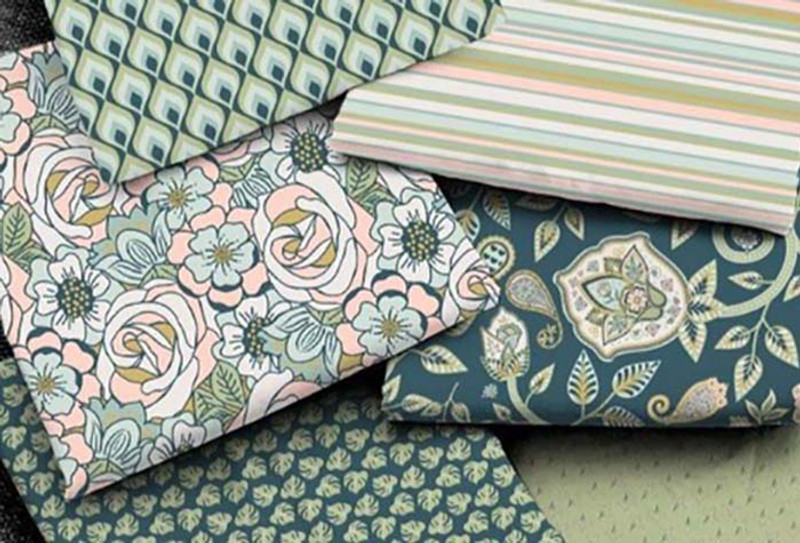
Quilting Tips - Fussy Cutting and Fat Quarters
Published by Nannette D. | The Textile District on Sep 14th 2023
Updated September 2026 to reflect current Fat Quarter assortments, quilting guidance and site links.
Fussy cutting is a quilting technique that lets you isolate and feature a specific motif from a printed fabric. Instead of cutting pieces wherever they fall on the yardage, you intentionally position the cut so a flower, animal, geometric element or other focal detail lands exactly where you want it in the finished block.
Fat quarters are especially useful for this technique because their wider shape gives you more room to position templates around individual motifs. In this guide, we’ll explain how fussy cutting works, what to look for in a print and how to plan your cuts before sewing.
Shop Artist-Designed Fat Quarter Bundles
What Is a Fat Quarter?
A traditional fat quarter measures approximately 18" × 21". Unlike a standard quarter-yard cut, which is long and narrow, a fat quarter is created by dividing a half-yard section across the width.
The wider shape makes fat quarters especially useful for quilt blocks, patchwork, appliqué, bags, napkins and projects where you want more flexibility in how individual motifs are positioned.
The Textile District’s Fat Quarter assortments include twelve coordinated artist-designed prints on Cotton Quilt fabric. Each assortment is supplied as three continuous yards so you can cut the twelve fat-quarter sections when you are ready to sew.
Read: Fat Quarter Bundles for Quilting and Sewing
What Is Fussy Cutting?
Fussy cutting means intentionally cutting around a specific part of a fabric design so that the selected motif becomes a focal point in your quilt block or sewing project.
For example, you might center a flower inside a square block, isolate a single illustrated object for appliqué or repeat the same motif across several blocks for a more structured layout.
The technique works especially well with prints that contain:
- distinct flowers or botanical motifs
- animals or illustrated objects
- medallions and geometric shapes
- large-scale decorative elements
- repeating motifs with clear spacing
Choose a Fabric with a Strong Focal Motif
Start by looking for a design with clearly defined elements that can stand on their own when isolated.
Large-scale prints are often ideal because individual motifs are easier to identify and frame, but smaller repeats can work just as well when the motif fits comfortably inside the quilt block you are planning.
Before cutting, decide which part of the design you want to feature and how much surrounding background should remain visible.
Use a Clear Template
A clear acrylic quilting ruler or transparent template makes fussy cutting much easier because you can see the motif through the tool while positioning the cut.
Place the template over the fabric and move it until the focal element is centered or positioned exactly where you want it.
Once the placement is correct, mark or cut around the template carefully.
Remember the Seam Allowance
One of the most common mistakes in fussy cutting is positioning the motif too close to the edge of the cut piece.
Always account for the seam allowance before cutting. A motif that looks perfectly centered in the raw block can become cropped after the seams are sewn if it sits too close to the cutting line.
If you are using a ¼" quilting seam, visualize or mark the finished area inside the cut piece before committing to the cut.
Pay Attention to Print Direction
Directional prints require a little extra planning.
If a motif has a clear top and bottom, decide whether you want all of the blocks oriented in the same direction or intentionally rotated for a more playful composition.
Stripes, stems, animals, letters and illustrated objects are especially worth checking before cutting.
Plan Before You Cut
Lay out the fabric and identify several possible motifs before making the first cut.
If you are creating multiple blocks, consider how the selected motifs will relate to one another. You may want:
- the same motif repeated across several blocks
- different motifs from the same print
- a mix of focal prints and quieter coordinating fabrics
- repeated colors that connect the blocks visually
A design wall, cutting mat or flat work surface can help you preview the composition before sewing.
Use Sashing to Frame Fussy-Cut Blocks
Sashing can help isolate a featured motif and give the eye a place to rest between busier printed blocks.
Choose a coordinating or contrasting fabric depending on whether you want the sashing to blend into the quilt or create a stronger frame around each block.
The width is entirely flexible. Narrow sashing creates a more connected composition, while wider strips give each fussy-cut motif more visual separation.
Mix Fussy-Cut Blocks with Coordinating Prints
Not every block needs to contain a focal motif.
One effective approach is to combine fussy-cut pieces with smaller-scale coordinates, stripes, geometrics or tonal designs. This lets the featured motifs stand out without making the quilt feel visually crowded.
Fat Quarter assortments are especially useful for this because the prints are already coordinated by color and collection.
Featured Inspiration: Nostalgic by KerrynB Designs
The original examples in this article feature the Nostalgic collection by KerrynB Designs.
The collection includes several coordinated color stories with a mix of motifs suitable for patchwork and selective motif placement.
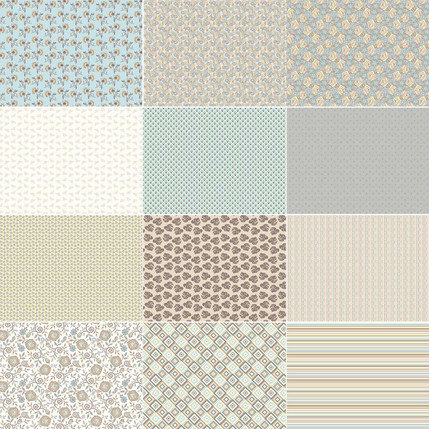

Rather than relying on one collection alone, you can apply the same fussy-cutting techniques to many of the floral, novelty, geometric and illustrated prints throughout the current Fat Quarter assortment.
Browse Current Fat Quarter Bundles
Why Cotton Quilt Works Well for Fussy Cutting
The Textile District’s Cotton Quilt fabric is lightweight, easy to press and stable enough for accurate cutting and piecing.
It is direct printed with OEKO-TEX® certified fiber-reactive dyes, then professionally steamed, washed and dried as part of the finishing process. No additional prewashing is required before sewing.
Try Fussy Cutting in Other Sewing Projects
Fussy cutting is not limited to quilts. The same technique can be used anywhere you want a particular part of a print to appear in a specific location.
Try it for:
- zipper pouches
- patch pockets
- fabric baskets
- appliqué
- small bags
- napkin corners
- quilt labels
- ornaments and handmade gifts
Explore More Fat Quarter Projects
Fat quarters are useful for both quilting and smaller sewing projects, especially when you want to combine several coordinating prints.